Feature
The 2.6° bug that locked our AI's knees
Every AI athlete had walked on knees that could bend 2.6 degrees instead of 150. A units bug read radians as degrees. How we found it, and what it meant.
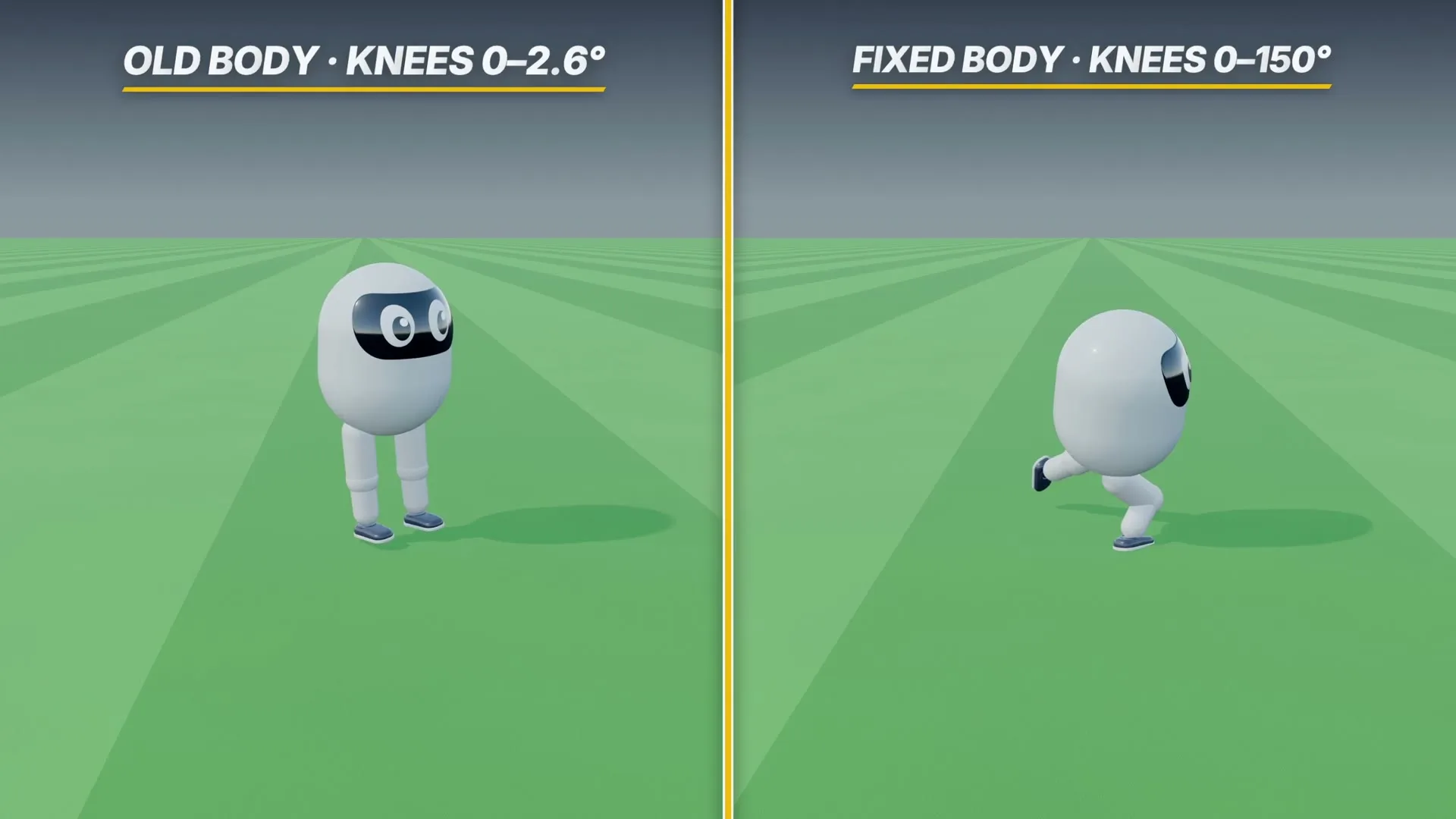
By try 26, Bolt could walk, dribble and score 80% of the time. Then we looked closely at its legs, and found that it had learned all of that with knees that barely bent.
What we saw
Bolt walked with a stiff, narrow shuffle. It looked like a style, and the AI had made it work. The bug turned up somewhere else: in a test teaching a fallen athlete to stand up.
The cause
The athlete’s body is written in code: its parts, its joints, and how far each joint may turn. We wrote those limits in radians. The physics engine, MuJoCo, reads joint limits in degrees unless it is told otherwise, and nobody had told it. So every limit was read as a tiny number of degrees:
| Joint | What it could do | What it should do |
|---|---|---|
| Knee | 0 to 2.6° | 0 to 150° |
| Hip, forwards and back | −1.9 to 0.7° | −110 to 40° |
| Hip, sideways and turning | ±0.6° | ±35° |
| Ankle | ±0.8° | ±45° |
Only the small give in the joints let the motors push a few degrees past those limits. Every AI until then had learned to walk, and Bolt to play football, on almost rigid legs.
What it meant
The body had been harder to control than intended, not easier, so what those AIs learned was still real. But none of it could carry over to a body with working knees. We fixed the body and started over from try 27.
That restart is its own story. Knees that bend opened up leaps, flips, skips, pattering and a stiff peg leg before try 36 finally walked.
The lesson
A unit is a silent assumption. The code and the engine both worked; they just disagreed about what a number meant. The fix was one line. Finding it took a test that couldn’t pass on the broken body, and a closer look at the footage.
See the bug and the fixed body side by side in episode 1 at 2:24.