Feature
Why our AI learned to walk backwards
An AI athlete taught itself to walk backwards and kick with its heels. The reason was in its points: nothing ever paid for facing forwards.
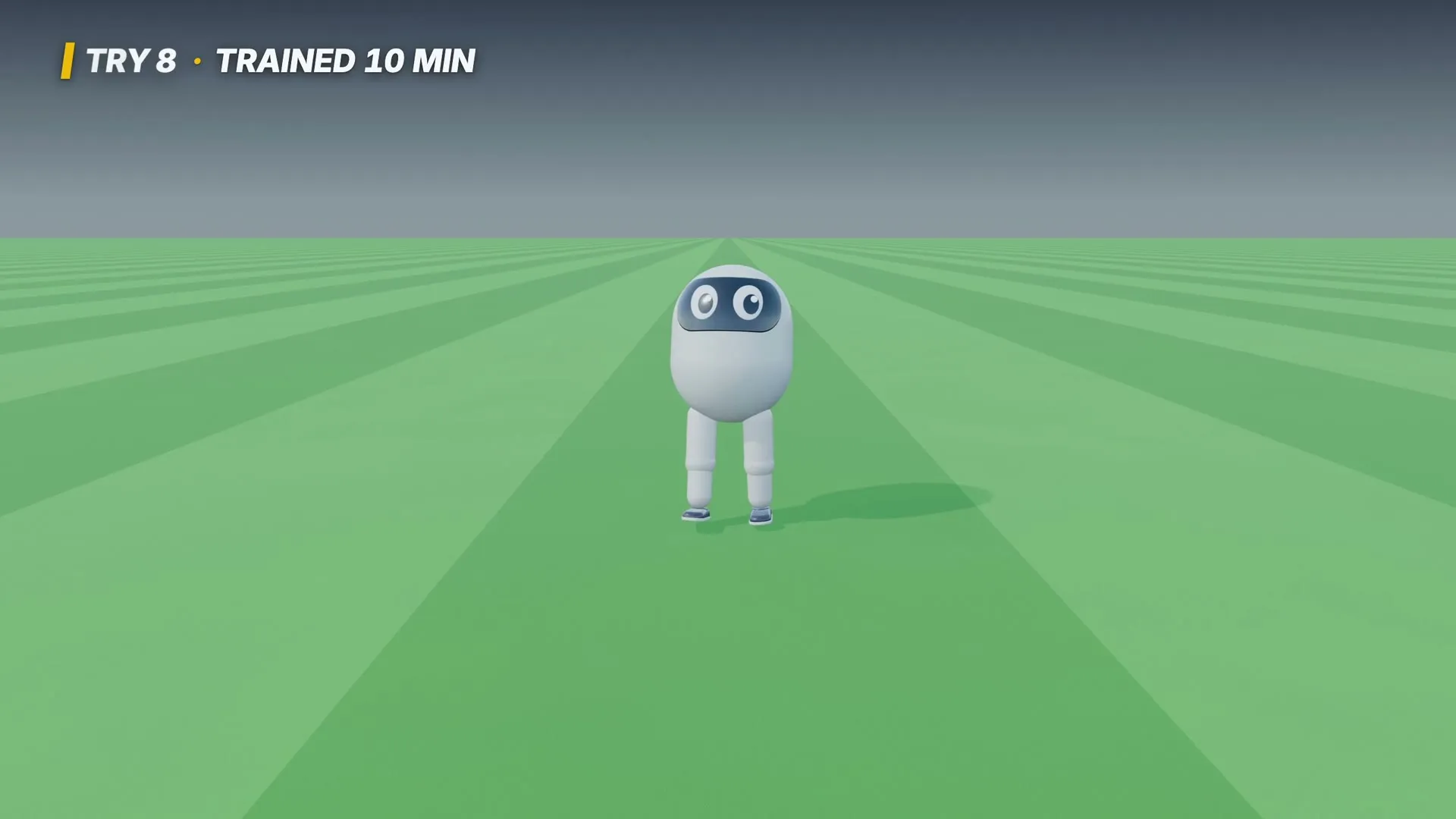
Try 8 learned to walk. It reached its targets, it stayed on its feet, and it did all of it facing the wrong way. Later brains even approached the ball backwards and kicked it with their heels.
It did what it was paid for
Our athletes learn by reinforcement learning: points for what we want, millions of attempts, and a slow drift towards whatever collects the most points. The walking points paid for getting closer to a target. The ball points paid for getting closer to the ball and moving it towards the goal. Nothing paid for facing the direction of travel.
So the AI had no reason to prefer forwards. For this body, with short legs under a round torso, walking backwards happened to work, so it walked backwards. In the recorded physics, the walking brain moved backwards in 107 of 107 moving samples. This isn’t a glitch in the physics. It is the AI finding a perfectly good answer to the question we actually asked.
How it was found
Our checks looked for the failures we expected: crawling, walking on its knees, falling. None of them asked which way it faced. The backwards walk was spotted by eye, in the first full clip. A two-second preview and side-on stills had hidden it.
The fix
We added a facing term to the points: moving along the body’s forward axis pays, and moving backwards costs more. Try 24 learned with it and walked forwards at last. Forward walking even passed its test sooner than the backwards one had, though it walked a little slower: 0.94 metres a second against 1.3.
The lesson
Reinforcement learning is literal. An AI will satisfy the points you write, not the intention behind them, and it will find shortcuts you never imagined. The cure is twofold: say what you want more precisely, and watch the footage early, asking the obvious questions. Which way is it facing? Are both legs working?
The backwards walker is in episode 1 at 0:40. For more on how the points work, read what reinforcement learning is.